Toe clips and other odds and ends
23/01/11 15:34 Filed in: Cycling
I’ve never been pleased with the way the black pedals looked on the Falcon. The appearance of classic quill pedals seems more befitting of the bike, so I chose the MKS AR2. This is a single sided pedal requiring some attention to ensure the proper side is against the sole of the shoe; since this is necessary anyway, I figured I might as well try toe clips. I did initially use them without clips, but found them dangerously slippery under a relatively flat soled sneaker. It’s difficult to find the actual extension measurements of toe clips and the sizes S, M, L, XL, are potentially misleading. Therefore, I initially bought a pair of MKS Medium only to find them too short for my size 10s. Not wanting to take any chances, I next got the XL or LL size, which are probably slightly too long but very comfortable. These measure 75 mm from the pedal interface to their farthest point, while the mediums measure 55.

In practice, I like the way that my foot feels securely attached to the pedal, releasing me from making any mental or muscular effort in that regard. This allows one to pull up on the back of the pedal stroke and dig down to push back on the downstroke. It makes bunny hopping road irregularities easier and safer. I leave my strap slightly loose since I ride primarily in the city, so I can easily slip a foot out when I stop (haven’t mastered the track stand yet). The principal detriment is the effort needed to get the pedal flipped and my foot into the clip when starting, particularly in traffic. I always leave one foot inserted and then, usually, pedal on the wrong side to pick up a little speed, coast, then flip the pedal and insert my foot without looking down. Preferably, I would catch the pedal as it came up on the first stroke, which is possible if I make a leisurely start, an uncommon occurrence in intersections. The other problem is toe overlap, which is compounded by the tight geometry of my frame and the fenders. I’ve placed the clips as distant from center as possible and just keep the fact in mind when turning sharply. In retrospect, a pedal like the MKS Touring might suit my needs better because it’s double sided.
I recently purchased an Axiom Streamliner DLX rear rack because I was tired of carrying so much in a messenger bag. To me, weight seems less draining when it’s not on one’s body. I chose this rack for its low weight and sleek appearance. It tapers as it rises, which causes it to look more integrated with the bike, while keeping pannier loads closer to the center of the bicycle. This also means it has a smaller top surface to lash luggage to. It is intended for modern bikes with braze on bolt fittings, so required some modification and use of clamps to attach it to my frame.
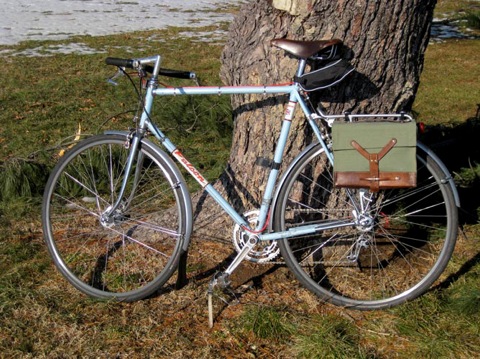
To go along with the rack, I got a Swiss Army Ammunition bag on Ebay. I am not the first with this idea, though I did attach it a little differently. Most of the ones I’ve seen attach with the use of hooks that fit over the top rail of the rack, with a further strap attachment below, both attached to the leather reinforcement. This means the top of the bag sits above the top of the rack, lessening the ability to strap other items to the rack. I was also concerned that the hooks would get caught on things when the bag was carried around. I chose to affix D-rings to the leather reinforcement, attaching the bag to the rack with toestraps, and dispensing with any lower attachment, since the rack is angled. This way, I have a flat surface atop the rack, and can securely clip a strap to the D-rings for carrying the bag off the bike. I will admit that the bag is probably more fiddly to attach, but it bounces very little due to the angle of the rack.
In practice, I like the way that my foot feels securely attached to the pedal, releasing me from making any mental or muscular effort in that regard. This allows one to pull up on the back of the pedal stroke and dig down to push back on the downstroke. It makes bunny hopping road irregularities easier and safer. I leave my strap slightly loose since I ride primarily in the city, so I can easily slip a foot out when I stop (haven’t mastered the track stand yet). The principal detriment is the effort needed to get the pedal flipped and my foot into the clip when starting, particularly in traffic. I always leave one foot inserted and then, usually, pedal on the wrong side to pick up a little speed, coast, then flip the pedal and insert my foot without looking down. Preferably, I would catch the pedal as it came up on the first stroke, which is possible if I make a leisurely start, an uncommon occurrence in intersections. The other problem is toe overlap, which is compounded by the tight geometry of my frame and the fenders. I’ve placed the clips as distant from center as possible and just keep the fact in mind when turning sharply. In retrospect, a pedal like the MKS Touring might suit my needs better because it’s double sided.
I recently purchased an Axiom Streamliner DLX rear rack because I was tired of carrying so much in a messenger bag. To me, weight seems less draining when it’s not on one’s body. I chose this rack for its low weight and sleek appearance. It tapers as it rises, which causes it to look more integrated with the bike, while keeping pannier loads closer to the center of the bicycle. This also means it has a smaller top surface to lash luggage to. It is intended for modern bikes with braze on bolt fittings, so required some modification and use of clamps to attach it to my frame.
To go along with the rack, I got a Swiss Army Ammunition bag on Ebay. I am not the first with this idea, though I did attach it a little differently. Most of the ones I’ve seen attach with the use of hooks that fit over the top rail of the rack, with a further strap attachment below, both attached to the leather reinforcement. This means the top of the bag sits above the top of the rack, lessening the ability to strap other items to the rack. I was also concerned that the hooks would get caught on things when the bag was carried around. I chose to affix D-rings to the leather reinforcement, attaching the bag to the rack with toestraps, and dispensing with any lower attachment, since the rack is angled. This way, I have a flat surface atop the rack, and can securely clip a strap to the D-rings for carrying the bag off the bike. I will admit that the bag is probably more fiddly to attach, but it bounces very little due to the angle of the rack.